Whoo-wee! It's Friday. It's our last day with this group of students. Next week I will be leading a brand new group with this same information. So next week's posts will just be what I'm noticing instead of a full breakdown, just so you know!
After the math vocabulary stickers and roll call I jumped in and took over the Estimation Problem for the day. I wanted to get my feet wet and ready for Monday. Today it was about the height of a Ferris Wheel, but they gave us a clue when they included the guy from Monday's estimation. The students had to remember that his height was 6'4". It was funny to watch them all immediately pinch their fingers on the picture and then try to count up how many of those it would take to reach the top of the wheel. Since this was an inaccurate and unsteady way of measuring many only got about half of the correct numbers of people to count.
I also asked the teacher participants to weigh in with their estimations and share their strategies. One of them brought up the idea of just counting up half way and then doubling it. Which leads right into today's Number Talk strand!
If we used 64 x 1 and then showed them 32 x 2 can they 'decompose' (ask them to use the correct terms we discussed yesterday) the 32 into 30 and 2 so that the problem could be (2 x 30) + (2 x 2)? Highlight any strategies shared that came from our lessons this week, such as Area Model or Number Lines.
Today's Activating Strategy was called Eliminate it. There's a table with four two digit numbers in them. They are just random. Tell the students that there is no right or wrong way to answer this question. But look at all four and remove one of them from the rest. Make sure that you stress that the student talks through their math reasoning behind why they selected that number. Have them refer to the place values of the numbers, or the odd-evenness, prime-composite, digit is repeated, etc.
Next was time for only one workstation rotation today.
Yesterday I gave you some homework to do research into Three Act Tasks. Dan Meyers created a google doc that he is sharing about various math problems in LiveBinders. Students watch a little video or look at a picture. Then they talk out what they notice and IMPORTANTLY try to determine what the video could be asking. They estimate, placing their guesses on a number line with LOW choice at one end, and HIGH choice at the other. Their estimate falls somewhere on this line. Students need to determine what information is needed to solve their selected question. Then they work through the math and offer up suggestions for results, justifying their reasonings.
You get to decide if you reveal the answer, or let them walk away without solving it.
We had a survey for the students to complete, so we stopped today earlier than usual.
Next week is all me with four teachers watching me conduct these lessons for 16 students.
EEK!

Showing posts with label Math. Show all posts
Showing posts with label Math. Show all posts
Friday, June 02, 2017

Thursday, June 01, 2017
Math - It's Whats for Breakfast - Day Three
Good morning Mathematicians,
If you're as bad as me at staff developments you see some great ideas and immediately want to try them out. Which translates into DollarStore Run!
My Coordinator had these great little 3x5 corkboard picture frames with the Station Labels attached to them. I had to get them and of course couldn't find exactly what I wanted. I did grab some 3x5 frames with a shadowbox effect. I removed the glass and cut up some scrapbook papers to color coordinate with my table colors (red, blue, green, purple). I have table buckets in these colors to keep materials organized. I have even spray painted the backs of my student white boards to coordinate as well.
Yesterday I noticed that the Coordinator picked out one or two students to highlight for each activity. I found these great small plastic traffic cones printed with "Great Job!" "Awesome!" or "Way to Go!" I grabbed a couple of these to give out at each table to "Make You Famous" and know who to call on when I need a student to explain. I will watch for the student who mostly seems to understand the math behind the concept to give this award to.
I also grabbed some Mardi Gras beads - 8 for a $1 with colors that coordinate with my tables. When the students arrive for my class next week I am going to ask them to select a color and sit at that table as a means of separating my groups on the first day. I will then assign tables according to ability for the next two days. This requires some quick assessment of these new students as they work through the math activities on Day One.
Now, on for today's Math Work:
Focus - Variables - a symbol that takes place of the unknown
We started with Math Vocabulary and worked through their definitions. Another estimation from this great site called Estimation 180. It has enough for EVERY day of the school year...umm, hence the name, right?
We worked through another set of Number Talks. Today the strand was Doubling and Halving where the students will try to break apart or 'decompose' one of the factors - 3 x 2 x 6 - to make it easier to handle. My Fourth Graders haven't been introduced to PEMDAS, so that conversation didn't come up. The students did fine with this and even with the Commutative Property problem. What caused them trouble was when we extended it to a four digit expression - 6 x 6 x 2 x 12. They started zoning out and were not confident in their strategies. We moved on after some extended Wait Time. Remember - Today is not the time to teach new concepts.
Currently, we are working through some Multiplicative Comparison Problems. Asking the students to discuss what they already know and what they need to know gives them a focus. The problems were picked because they included skills that the students should already posses, they required them to explain or prove their thinking, and included an engaging portion that activates what they will be learning in an upcoming lesson.

There is an Activating Question first, kind of a We Do. A Teach Question, like an I do. Then an Active Engagement Question, You Do. Students need to talk out what they already know and what is the question asking us to solve. Can they write an equation? You can refer back to the Anchor Chart to help them understand that words like 'is' and 'times' translate into math symbols. We want to get the students to be thinking about the 'variables.' They can use their number lines to show the sets from the problems.
We moved into Workstations next. There are four and students are given 20 minutes at each. There is an I\ndependent station where students work with pencil paper questions. There's a Group Work station where they are to discuss with each other how to approach and solve the problems provided. The Teacher Led Workstation has three Multiplicative Comparison problems that uses the same numbers each time, however you are guiding the students to see that the product will NOT always be the same. Students are given permission to use number lines, white boards, and snap cubes to help them solve. The computer station uses MathPlayground to check their understanding of multi-step word problems. Students work independently here and if they finish early they can choose a different game from this site to work on.
We started a Three Act Task. If you aren't familiar with teaching method, I'm going to give you some homework to research it before tomorrow's blog post.
See you then!
If you're as bad as me at staff developments you see some great ideas and immediately want to try them out. Which translates into DollarStore Run!
My Coordinator had these great little 3x5 corkboard picture frames with the Station Labels attached to them. I had to get them and of course couldn't find exactly what I wanted. I did grab some 3x5 frames with a shadowbox effect. I removed the glass and cut up some scrapbook papers to color coordinate with my table colors (red, blue, green, purple). I have table buckets in these colors to keep materials organized. I have even spray painted the backs of my student white boards to coordinate as well.
Yesterday I noticed that the Coordinator picked out one or two students to highlight for each activity. I found these great small plastic traffic cones printed with "Great Job!" "Awesome!" or "Way to Go!" I grabbed a couple of these to give out at each table to "Make You Famous" and know who to call on when I need a student to explain. I will watch for the student who mostly seems to understand the math behind the concept to give this award to.
I also grabbed some Mardi Gras beads - 8 for a $1 with colors that coordinate with my tables. When the students arrive for my class next week I am going to ask them to select a color and sit at that table as a means of separating my groups on the first day. I will then assign tables according to ability for the next two days. This requires some quick assessment of these new students as they work through the math activities on Day One.
Now, on for today's Math Work:
Focus - Variables - a symbol that takes place of the unknown
We started with Math Vocabulary and worked through their definitions. Another estimation from this great site called Estimation 180. It has enough for EVERY day of the school year...umm, hence the name, right?
We worked through another set of Number Talks. Today the strand was Doubling and Halving where the students will try to break apart or 'decompose' one of the factors - 3 x 2 x 6 - to make it easier to handle. My Fourth Graders haven't been introduced to PEMDAS, so that conversation didn't come up. The students did fine with this and even with the Commutative Property problem. What caused them trouble was when we extended it to a four digit expression - 6 x 6 x 2 x 12. They started zoning out and were not confident in their strategies. We moved on after some extended Wait Time. Remember - Today is not the time to teach new concepts.
Currently, we are working through some Multiplicative Comparison Problems. Asking the students to discuss what they already know and what they need to know gives them a focus. The problems were picked because they included skills that the students should already posses, they required them to explain or prove their thinking, and included an engaging portion that activates what they will be learning in an upcoming lesson.

There is an Activating Question first, kind of a We Do. A Teach Question, like an I do. Then an Active Engagement Question, You Do. Students need to talk out what they already know and what is the question asking us to solve. Can they write an equation? You can refer back to the Anchor Chart to help them understand that words like 'is' and 'times' translate into math symbols. We want to get the students to be thinking about the 'variables.' They can use their number lines to show the sets from the problems.
We moved into Workstations next. There are four and students are given 20 minutes at each. There is an I\ndependent station where students work with pencil paper questions. There's a Group Work station where they are to discuss with each other how to approach and solve the problems provided. The Teacher Led Workstation has three Multiplicative Comparison problems that uses the same numbers each time, however you are guiding the students to see that the product will NOT always be the same. Students are given permission to use number lines, white boards, and snap cubes to help them solve. The computer station uses MathPlayground to check their understanding of multi-step word problems. Students work independently here and if they finish early they can choose a different game from this site to work on.
We started a Three Act Task. If you aren't familiar with teaching method, I'm going to give you some homework to research it before tomorrow's blog post.
See you then!
Math - It's What's for Breakfast Day Two
Teachers, congratulations if you got through yesterday's post. Summer Brain is a real thing, people. Once those school buses drive off the lot, it turns on. So kudos if you managed to get through Day One of Summer Math Institute with me!
Today the teachers arrived a half hour before the students in order to preview the day. The biggest thing our coordinator stressed was that we need to 'Step Back' and let the students take over. This session is not for teaching any new skills, it's strictly to observe how students approach and attack math problems. We want to witness their reasoning skills in action. As teachers we can notice concepts that we need to address during tomorrow's mini-lesson or bringing up in small groups as needed.
12 students came tumbling into our room and we got right to work asking them to pick out a Math Vocabulary Sticker to wear for the day. In their journals they have a spot for them to write out what they think their term means and illustrate it. We shared those out loud with the group. They were a bit shy and needed some coaxing, but this activity got them talking and thinking about math already.
We are focusing on strategies to bring NUMBER LINES into more math lessons this week. So we had some activating strategies to see what the group was already capable of doing. We handed out a plastic one that had a blank side and a ticked side. It was interesting to see how few of them actually understood how to use these as a tool.
Another issue I noticed to address with these students is as they approach math exemplars, or word problems, they seemed obsessed with taking whatever the first two numbers are in the problem and adding or multiplying them. To slow them down at the beginning of the year don't stress out on finding the answers but rather concentrating on deciphering the problem. What do you know? What do the numbers mean? What are they asking you to do?
Number Talks was a huge "Aha Moment" for me when I first saw this strategy at an earlier institute. Sherry Parrish (pdf - Number Talks video - Sherry Parrish ) is the Number Talks guru. It basically asks children to explain their thinking and use those strategies to teach the rest of the class additional ways of solving problems. It was interesting to listen to the students talk through their math. We had to cringe when students were off with their reasoning, but it helped us to see where holes were and how to address them in later math lessons.
The students were also asked to reflect on the class. They had a survey to complete sharing what they are already comfortable with in mathematics and then they wrote in their journals about Something I found challenging today… Tomorrow I am excited about…
Day One was a juggling act as we got used to the kids and they got used to us. Using the materials and showing their math thinking caused a lot of confusion. But by Day Three I think they will be experts.
Wednesday, May 31, 2017
Math-It's What's for Breakfast - Day One
Umm, what was I thinking? It is 8:05 A.M. on my first official day of summer vacation. Here I sit in a school cafeteria, learning about how to teach MATH! It is start of the 2017 Summer Math Institute. I have attended several of these in the past and gotten tons out of them, but only as a participant. Somewhere along the way my name was submitted to TEACH the class this year.
Our first order of business was an ice breaker called Math Mingle. Think of those fresh faces on the first day of school full of interest, yet still doubtful. Ask them to stand up and introduce themselves to other people in the room, a.k.a. mingle. After a brief period call "Freeze" and give them a task to solve such as: "Make a group of people that share the same number of letters in their first name." Students will arrange themselves into groups by calling out numbers or holding up fingers, etc. Once that is settled ask them to start mingling again and repeat the process. Depending on the age of your students you can create appropriate math level tasks. Since I teach Fourth Grade I could ask my class to "Form groups that equal the same number of cups in 2 quarts," or "Form groups that has the same number of equal sides as an isosceles triangle."
Next was a 5-minute game of Math Pictionary. One person is given a card with 18 grade level appropriate terms on it. They will draw each term without speaking, trying to get their team to say the correct word. A point is scored for each correct guess. Extra point is given at the end if the drawer used no numbers or words in their drawing. You can use this as another ice breaker to see how much they already know or retained from last year. You could also use this as a review once you are finished a new unit.
Here is a suggested vocabulary list for the beginning of Fourth Grade:
1. Commutative Property 2. Array 3. Isosceles Triangle 4. Pictograph 5. Fraction 6. Elapsed Time 7. Tens Place 8. Rounding 9. Sum 10.
Time for some professional development. We read an article on the research behind introducing algebra at the elementary level and shared sentences, phrases, and words that stood out to us. It was interesting to think that primary students could still reason out answers to expressions that ask them to solve for unknowns without any direct instruction.
Now we are thinking about Vertical Progression of a standard. Our county has broken down each standard and provided Achievement Level Descriptors in grades 3-5. They are finalizing the K-2 as we speak. We were given a table with Emerging, Developing, Proficient, and Distinguished. The standard was broken into each category onto small cards. Our table was charged with the task to organize them into the correct categories. We were successful at our table, by the way. It's important to think about how students are performing on each standard as you form groups and assign tasks. This is a great way to create your small groups and differentiate according to their strengths. It also helps to think about how to reduce a standard down to its smallest parts in order to scaffold for those students that are starting at the Emerging Level.
After a short break we are smacked back awake. We are struggling through a Mobile Puzzle, or Logical-mathematical puzzle.

To me this is a Distinguished Level Task. To give this to a student who is working off of an Emerging Level, like me, they would check out pretty quickly after being easily frustrated. This task would require a lot of scaffolding for them to see the rules and patterns of how these numbers balance and relate to each other.
We broke for the day. Whew! Summer Brain is already setting in.
Our first order of business was an ice breaker called Math Mingle. Think of those fresh faces on the first day of school full of interest, yet still doubtful. Ask them to stand up and introduce themselves to other people in the room, a.k.a. mingle. After a brief period call "Freeze" and give them a task to solve such as: "Make a group of people that share the same number of letters in their first name." Students will arrange themselves into groups by calling out numbers or holding up fingers, etc. Once that is settled ask them to start mingling again and repeat the process. Depending on the age of your students you can create appropriate math level tasks. Since I teach Fourth Grade I could ask my class to "Form groups that equal the same number of cups in 2 quarts," or "Form groups that has the same number of equal sides as an isosceles triangle."
Next was a 5-minute game of Math Pictionary. One person is given a card with 18 grade level appropriate terms on it. They will draw each term without speaking, trying to get their team to say the correct word. A point is scored for each correct guess. Extra point is given at the end if the drawer used no numbers or words in their drawing. You can use this as another ice breaker to see how much they already know or retained from last year. You could also use this as a review once you are finished a new unit.
Here is a suggested vocabulary list for the beginning of Fourth Grade:
1. Commutative Property 2. Array 3. Isosceles Triangle 4. Pictograph 5. Fraction 6. Elapsed Time 7. Tens Place 8. Rounding 9. Sum 10.
Time for some professional development. We read an article on the research behind introducing algebra at the elementary level and shared sentences, phrases, and words that stood out to us. It was interesting to think that primary students could still reason out answers to expressions that ask them to solve for unknowns without any direct instruction.
Now we are thinking about Vertical Progression of a standard. Our county has broken down each standard and provided Achievement Level Descriptors in grades 3-5. They are finalizing the K-2 as we speak. We were given a table with Emerging, Developing, Proficient, and Distinguished. The standard was broken into each category onto small cards. Our table was charged with the task to organize them into the correct categories. We were successful at our table, by the way. It's important to think about how students are performing on each standard as you form groups and assign tasks. This is a great way to create your small groups and differentiate according to their strengths. It also helps to think about how to reduce a standard down to its smallest parts in order to scaffold for those students that are starting at the Emerging Level.
After a short break we are smacked back awake. We are struggling through a Mobile Puzzle, or Logical-mathematical puzzle.
To me this is a Distinguished Level Task. To give this to a student who is working off of an Emerging Level, like me, they would check out pretty quickly after being easily frustrated. This task would require a lot of scaffolding for them to see the rules and patterns of how these numbers balance and relate to each other.
We broke for the day. Whew! Summer Brain is already setting in.
Sunday, September 27, 2015
Sharing Sunday

Do you realize that I've been in school a total of 8 weeks already? EIGHT! That's two whole months of back to school. This also means there's only one more before the end of the first marking period. Whoa! So fast. It often feels like time is slogging through the quicksand as you go day to day. Before you know it though, you look up and the first marking period is over.
Life is definitely in fast forward and it's hard to find time to just breathe. The fine folks over at Primary Peach have come up with a solution to the Merry-Go-Round this month. I am linking up with their Sharing Sunday to help you plan out the month ahead. Give you a little time to do those things you love - eat, sleep, go to the bathroom, read a book.
I've got some fun ideas for your ELA and Math blocks below.
****************************************
*Click on the image below to get to the file where you can click each link.

****************************************
*Scroll down to the second file to see the links for this page

Hope these help you out this month as the holidays start approaching. Maybe you'll have time to carve a pumpkin, or start that early Christmas shopping. Who knows!
****************************************
Check back here for more information about the Primary Peach Link Up
Wednesday, September 10, 2014
Oh Snap! Rounding Card set
At our last grade level meeting we were trying to brainstorm some great ideas to help our students with rounding. We were trying to figure out a way to have the students play a card game that might include some rounding. It wasn't working out exactly how we wanted.
I went home with Rounding on the brain and started googling some fun kid card games and found one that might work called Snap. It was pretty basic having the players turn over a card from a draw pile until a match was made. Whoever yelled, "Snap!" first won the hand. It got me thinking.
The idea for Oh Snap! Rounding version was born.
I brought the card set with four different colors and levels into the classroom the next day and let the kids play around with it. They immediately took to it and wanted to put in each of the higher, and harder, levels.
I videotaped them playing a round here if you are interested:
The card set is up for grabs at my store here.
The red card set is the first level where the numbers are written to the hundreds place. The students have to round to the nearest tens for each card. The second level is up to the thousands and rounding to the hundreds. There are two more levels that add more place values as you go.
The higher the levels go the more closer some of the numbers round to. So you really have to be paying attention in order to win the hand.
Fun times!
I went home with Rounding on the brain and started googling some fun kid card games and found one that might work called Snap. It was pretty basic having the players turn over a card from a draw pile until a match was made. Whoever yelled, "Snap!" first won the hand. It got me thinking.
The idea for Oh Snap! Rounding version was born.
I brought the card set with four different colors and levels into the classroom the next day and let the kids play around with it. They immediately took to it and wanted to put in each of the higher, and harder, levels.
I videotaped them playing a round here if you are interested:
The card set is up for grabs at my store here.
The red card set is the first level where the numbers are written to the hundreds place. The students have to round to the nearest tens for each card. The second level is up to the thousands and rounding to the hundreds. There are two more levels that add more place values as you go.
The higher the levels go the more closer some of the numbers round to. So you really have to be paying attention in order to win the hand.
Fun times!
Monday, August 25, 2014
Place Value Stations Check Up
Hi y'all,
I told you I would be back once I had used all of the Math Place Value Stations in my room.
The kids seemed to take well to the idea of playing 'games' while learning math. I had introduced a few to them and then showed them the rest.

Each group go to pick one and play it until Math Workshop was over. A lot of them asked for the 'Go Fish' style game, Rustle Up Some Vittles. I did have to explain what Rustle and Vittles meant, but they got it. You should have seen how large their eyes got when I said that the Red Level card set had numbers in the Millions Place. You'd think they'd never seen a number that high before. I'm afraid to share what the National Debt is with them.

All of them are now in a separate bucket and many want to take stuff out when they've finished their work. Snake Bite is a huge hit for some reason.

They caught on quickly to the concepts and are enjoying them. That's what I wanted most when I set out to create this pack, so color me happy. I like that I can pull these games out further down the road, but on the higher levels once they master the concepts. Or not. We'll see.
I told you I would be back once I had used all of the Math Place Value Stations in my room.
The kids seemed to take well to the idea of playing 'games' while learning math. I had introduced a few to them and then showed them the rest.

Each group go to pick one and play it until Math Workshop was over. A lot of them asked for the 'Go Fish' style game, Rustle Up Some Vittles. I did have to explain what Rustle and Vittles meant, but they got it. You should have seen how large their eyes got when I said that the Red Level card set had numbers in the Millions Place. You'd think they'd never seen a number that high before. I'm afraid to share what the National Debt is with them.
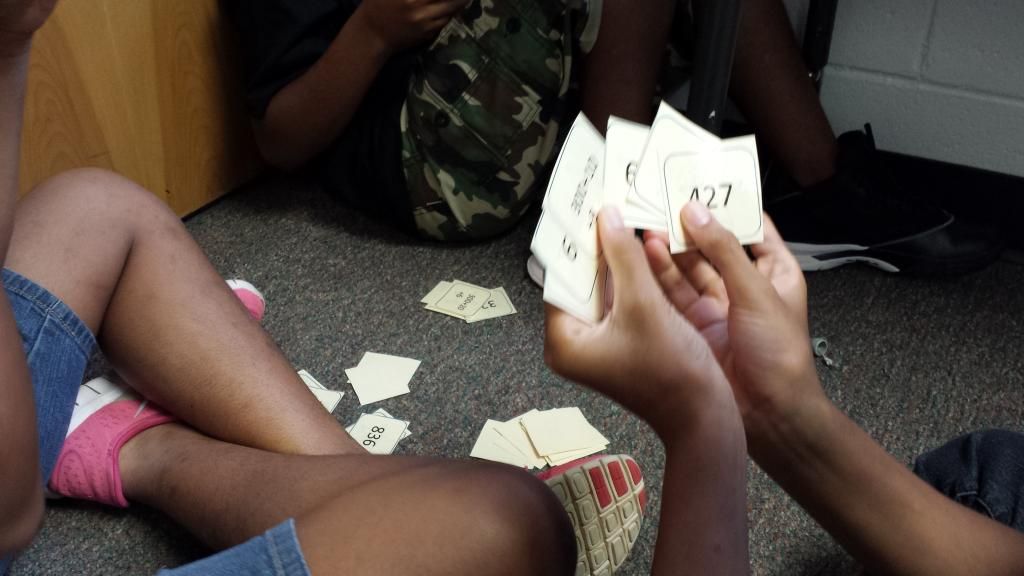
All of them are now in a separate bucket and many want to take stuff out when they've finished their work. Snake Bite is a huge hit for some reason.
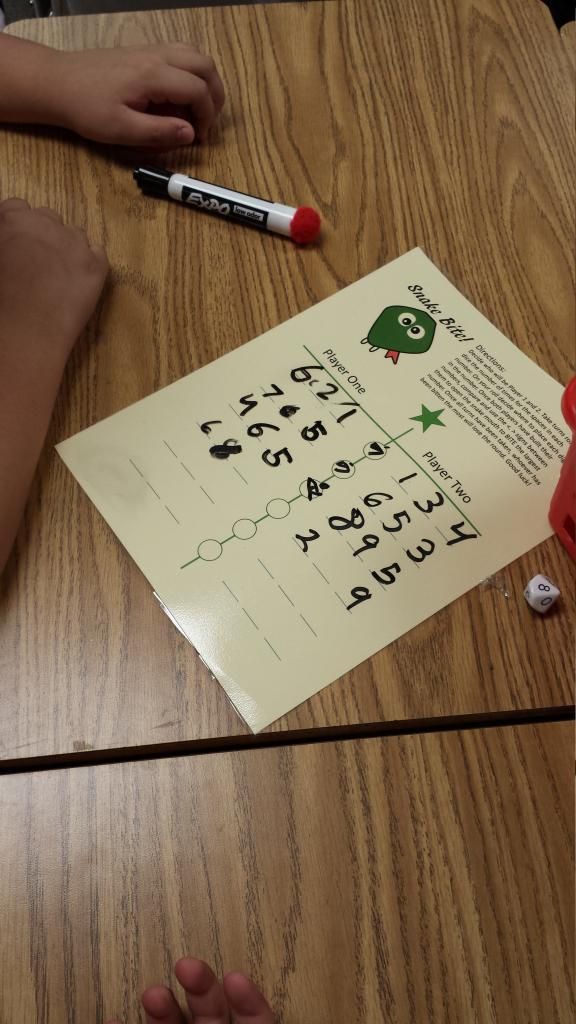
They caught on quickly to the concepts and are enjoying them. That's what I wanted most when I set out to create this pack, so color me happy. I like that I can pull these games out further down the road, but on the higher levels once they master the concepts. Or not. We'll see.
Monday, August 18, 2014
Place Value Stations and a TpT Second Chance Sale
How sad were you to see the annual TpT Back to School Sale come and go? That meant that school was starting and life was about to descend again. If you're like me summer came and went way too quickly. I was mired in a home remodel that took up way too much of my time. I really wanted to spend some idle time creating some killer stuff for my TpT store.
Yeah, that didn't happen. It was too frenetic so I didn't getmuch anything done. But the workers are gone and the house has been officially released back into our hands. With that pressure being released my mind could get back into the groove of things and start creating again.
It felt so great coming up with ideas for my Place Value Stations pack. One of the areas I struggled with our new Math Workshop model last year was not having fun and engaging activities to help my students extend their knowledge. I wanted this kit to be something I would really use.
I created six Math games that deal with Place Value - reading, comparing, and rounding larger numbers. This is usually our first skill of the year and I wanted to crank it out to test run them in my own room. I have a broad spectrum of abilities in my room so I definitely needed to differentiate these stations. Each of the 6 games has three different versions, so essentially there are 18 games in all.
And I have them all done! Whoo HOO.
I am thankful that I have a test group to run these games through. They found that ONE mistake that I know y'all appreciate me fixing before sending your way. They had a lot of fun running around the room to play the Round Up Them Doggies. I posted ten posters around the room that have a rounded number at the top and a question at the bottom. Students are given an answer sheet and their small group was given a card to start with. They were to solve the problem on each card, record it on their sheet and then find the card in the room that has there answer on it. Then solve the next question and so forth until they had answered all ten cards.


The next station is called Around the Corral. Students play against one other person. They roll dice and each move that number of spaces around their game board. Both compare their numbers written in standard, word, or expanded. Whoever has the larger number gets to pick up a counter. The person with the most counters at the end wins the game.
My group is having difficulty reading numbers that are larger than thousands place. They really do have the basics for reading numbers and I know they will easily pick up larger values. These games hopefully will give them added practice in a fun engaging way.


I'll be posting how they respond to the other four games, so be on the lookout.
For now the games are already up at TpT and you can get them here:
Place Value Stations
OooOoOOh, but hey, if you wait until Wednesday, August 20th, TpT is having a Second Chance Back to School Sale for ONE MORE DAY!!
You can grab this pack for 20% less, or not and I can finally afford those extra Oreos for my class and our Moon Unit.
Leave me some comments below to let me know how you plan on using this pack.
Yeah, that didn't happen. It was too frenetic so I didn't get
It felt so great coming up with ideas for my Place Value Stations pack. One of the areas I struggled with our new Math Workshop model last year was not having fun and engaging activities to help my students extend their knowledge. I wanted this kit to be something I would really use.
I created six Math games that deal with Place Value - reading, comparing, and rounding larger numbers. This is usually our first skill of the year and I wanted to crank it out to test run them in my own room. I have a broad spectrum of abilities in my room so I definitely needed to differentiate these stations. Each of the 6 games has three different versions, so essentially there are 18 games in all.
And I have them all done! Whoo HOO.
I am thankful that I have a test group to run these games through. They found that ONE mistake that I know y'all appreciate me fixing before sending your way. They had a lot of fun running around the room to play the Round Up Them Doggies. I posted ten posters around the room that have a rounded number at the top and a question at the bottom. Students are given an answer sheet and their small group was given a card to start with. They were to solve the problem on each card, record it on their sheet and then find the card in the room that has there answer on it. Then solve the next question and so forth until they had answered all ten cards.


The next station is called Around the Corral. Students play against one other person. They roll dice and each move that number of spaces around their game board. Both compare their numbers written in standard, word, or expanded. Whoever has the larger number gets to pick up a counter. The person with the most counters at the end wins the game.
My group is having difficulty reading numbers that are larger than thousands place. They really do have the basics for reading numbers and I know they will easily pick up larger values. These games hopefully will give them added practice in a fun engaging way.


I'll be posting how they respond to the other four games, so be on the lookout.
For now the games are already up at TpT and you can get them here:
Place Value Stations
OooOoOOh, but hey, if you wait until Wednesday, August 20th, TpT is having a Second Chance Back to School Sale for ONE MORE DAY!!
You can grab this pack for 20% less, or not and I can finally afford those extra Oreos for my class and our Moon Unit.
Leave me some comments below to let me know how you plan on using this pack.
Tuesday, June 10, 2014
Tried it Tuesday - Singapore Math

I'm joining in on Holly's Tried it Tuesday linky party.
Have you heard of this new math model? Our school had a staff development on Singapore Math last year, but it was after school until late, so I couldn't stay. Those who did take it said it was really great. So when I saw it offered in our summer workshop sessions through the county I jumped at it. Granted it was only an hour and a half instead of the full 8 hour session, but I managed to get some good stuff out of it!
The instructor focused mainly on problem solving using this method. There were seven steps to follow.
Give the students an exemplar such as:
Itty and Bitty were doing their daily jumping jacks. Itty did 8 of them. Bitty did 4 times as many as Itty. How many jumping jacks did they do all together?
The students work through the following steps on paper or in their math journals.

You can see my attempt at solving this problem from the class today.
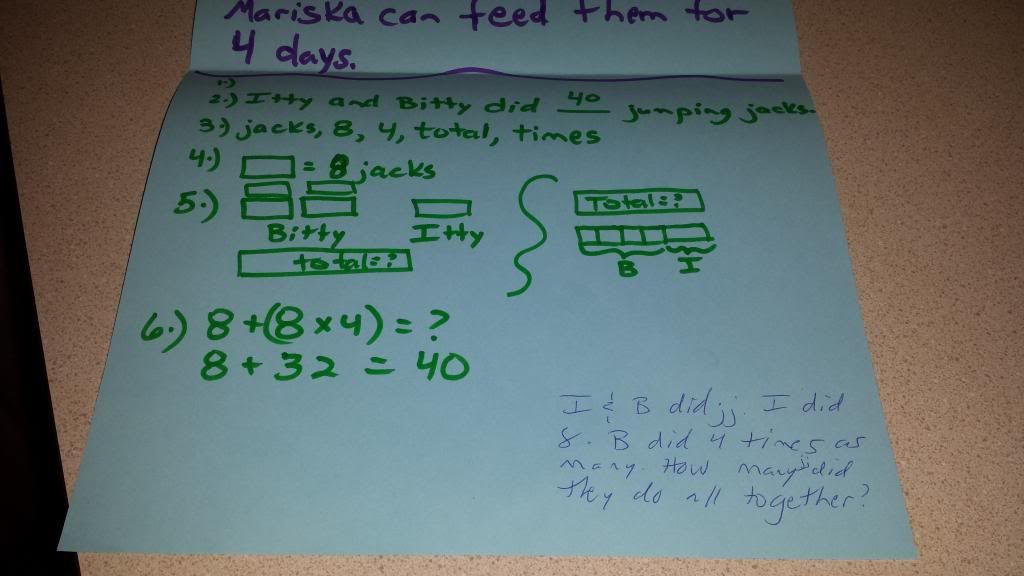
There were some great points that I noticed today. Students write the #1 next to the story problem to prove that they've read the entire problem first.
For #3 when they are trying to find the most important things, help them see that people's names or other extraneous information isn't necessary to solve the problem.
#4 when deciding on what 'unit' to pick as a representation in your drawing, you can only use information gathered from the actual story problem. Keep in mind that 'unit' DOES NOT always equal one. In subtraction problems 'unit' could stand for the whole amount.
#5 you can see me drawing bars out to solve and then 'adjusting them' on the right hand side to put them together into more of a bar model approach.
If students give you a three addend equation, like in #6, discuss with them which of the steps do they want to do first. Then explain how to use parenthesis to show the reader what to do first.
Students are then graded using a rubric where they get one point for each accurately followed step. They receive a 5 for following all directions correctly. They would receive only a 1 if they just list the answer as 40. So they can still get points even if they do not arrive at a correct answer. The effort is still rewarded.
I like this idea and can't wait to try it with my new students!
Disclaimer: I understand my knowledge of this is very rudimentary, so if y'all have used this and have tips, tricks, and/or suggestions I'd love to hear them. Comment, comment, comment.
Monday, October 14, 2013
Monday Mentor - Math Lit Connections
Today was a teacher workday, which translates into we were in meetings all morning. First we had an ESOL check up to make sure we were following our little darlings closely and adjusting curriculum to hit their weak areas. A lot of mine have problems in listening and speaking. I don't see much of a problem with their talking, they do that very well. But I digress.
Our next meeting was with our Literacy and Math coaches to plan out the next nine weeks. I can hardly believe the first quarter is done and gone. This second one always flies by. This year is going to be even worse because I literally will by flying by on Week 8 to Australia!! But I digress. The math coach did an awesome job collecting a ton of books for each teacher to have in their classroom. Each title addresses some math concept in fun new ways.
We had to pick from the bucket of goodness and come up with ways that we could use the book in our classroom. We could make mini lesson, whole group instruction, or station idea suggestions from our book. I grabbed this neat little book called Mystery Math: A First Book of Algebra by David A. Adler. It's October and this cover had all those perfect little ghosties and ghoulies on the cover. I used to love Halloween growing up but it seems to be squeezed out of the school system now.

This little nugget starts off teaching students what an equation is and why the two sides of an equal sign need to be balanced. Then it goes into variables and how to find the solution to algebra equations using all four mathematical operations. Mandy and Billy foolishly stop by a haunted house and have to solve the algebraic riddles to make it through. They count ravens on the wires, bats inside the belfry, and the obligatory skeletons in the closet. It's done in a simple and manageable style that I can't wait to try out on my students and make this a station for them to design their own story problems.
Hope you enjoy!
Our next meeting was with our Literacy and Math coaches to plan out the next nine weeks. I can hardly believe the first quarter is done and gone. This second one always flies by. This year is going to be even worse because I literally will by flying by on Week 8 to Australia!! But I digress. The math coach did an awesome job collecting a ton of books for each teacher to have in their classroom. Each title addresses some math concept in fun new ways.
We had to pick from the bucket of goodness and come up with ways that we could use the book in our classroom. We could make mini lesson, whole group instruction, or station idea suggestions from our book. I grabbed this neat little book called Mystery Math: A First Book of Algebra by David A. Adler. It's October and this cover had all those perfect little ghosties and ghoulies on the cover. I used to love Halloween growing up but it seems to be squeezed out of the school system now.
This little nugget starts off teaching students what an equation is and why the two sides of an equal sign need to be balanced. Then it goes into variables and how to find the solution to algebra equations using all four mathematical operations. Mandy and Billy foolishly stop by a haunted house and have to solve the algebraic riddles to make it through. They count ravens on the wires, bats inside the belfry, and the obligatory skeletons in the closet. It's done in a simple and manageable style that I can't wait to try out on my students and make this a station for them to design their own story problems.
Hope you enjoy!
Saturday, August 24, 2013
Mentor Monday - Number Talks
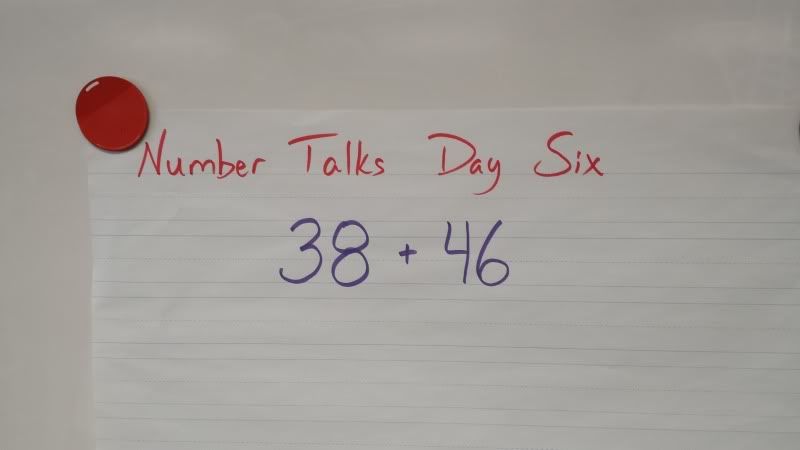
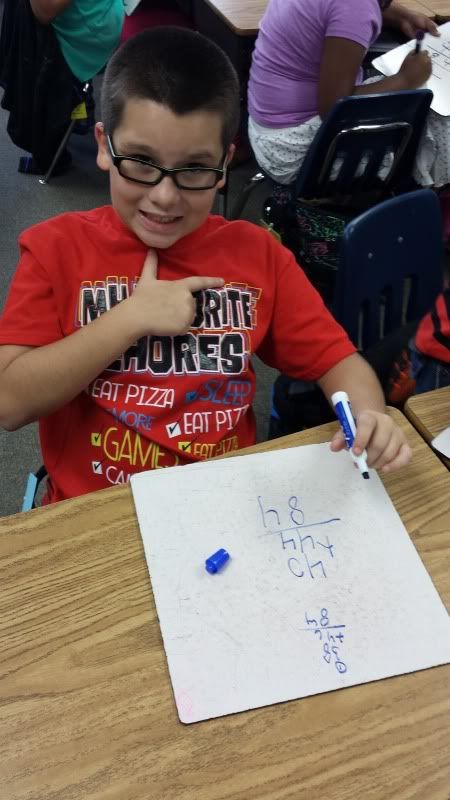
During a summer Math Institute I was introduced to the teacher's resource, Number Talks. It is a method used to get students to talk through their mathematical strategies. Questions such as 19+24 are posted on the board. Students try and solve it on a white board or paper. When they do, they hold a thumbs up against their chest to show they are done.

Now, if they can explain the strategy in one way, they hold up one finger along with the thumb. If they can explain two ways, they hold up two fingers and so on. This takes the stress away from those students who take a little longer to answer, or get frustrated and stop when they see all their friends already with answers.

The teacher's role is strictly as facilitator. This is the hardest part! You listen to the students as they explain their thinking to solve the problem. You then write or represent their explanations onto the board. Some may pull the numbers out into expanded form:
Now, if they can explain the strategy in one way, they hold up one finger along with the thumb. If they can explain two ways, they hold up two fingers and so on. This takes the stress away from those students who take a little longer to answer, or get frustrated and stop when they see all their friends already with answers.
The teacher's role is strictly as facilitator. This is the hardest part! You listen to the students as they explain their thinking to solve the problem. You then write or represent their explanations onto the board. Some may pull the numbers out into expanded form:
10 +9 and 20+4
10+20=30
9+4=13
30+13=43
Then add the two tens and the two ones and solve that way.
Or they might want to make 'friendly numbers' by taking one from the 24 and giving it to the 19.
24-1=23
19+1=20
23+20=43
Some may want to use a number line and use 'chunks' of numbers to find the answer. The teacher interprets their explanations into visual representations on the board or a chart. Then leaving the chart up for awhile so that the students can reference it during the next Number Talk.

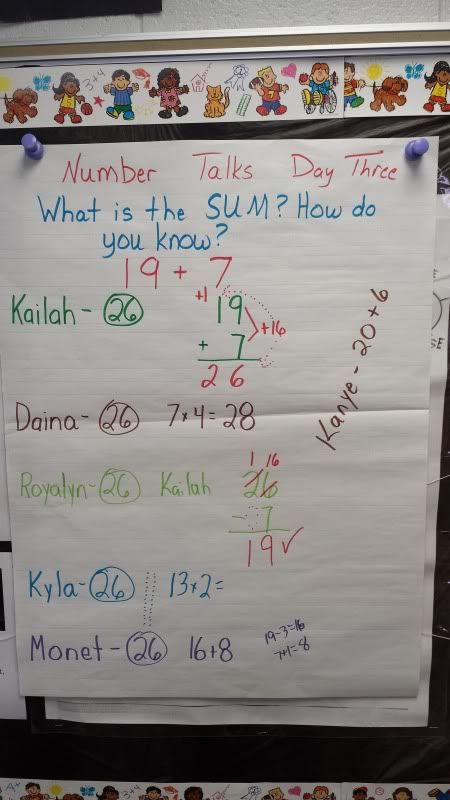
I'm finding it a bit difficult with this new method in deciding what to do when the student's method is incorrect, or they have difficulty explaining where they get their numbers from. I want to lead them down the correct path, but I have to hold myself back. It's interesting though to hear them talk through their strategies. I'm learning so much math right along with them. It's definitely going to be an interesting journey since math is not my best subject!
Monday, August 05, 2013
Monday Mentor - Setting up Notebook
Last week I showed you how I set up the student binders. Another thing we do at the beginning of the year is set up our Math Notebooks. Like a lot of you, we use the marbled composition notebooks for this purpose. The school provides us one for each student, so I can save a little money there.
The first thing I have them do is decorate the cover with ways they use numbers (photos, stickers, magazine ads, etc). This year I am going to follow the advice of Mrs. Hawk's Nest by hot gluing a ribbon into the back of their books so they can mark their place. So often they just flip to any old page and start working. I am WAY too OCD for that. I want the work to move chronologically through the book, so if I want to refer to something we've done in the past, I have them just open to that date.
I break the composition book into two sections. If you close the book and hold it up so you can see the top of all the pages, you'll notice a definite hole that marks the middle of the book. I have the students open to this page. We dog-ear (fold down) that page and make a chapter header for our 'Calendar' section. This is where they will complete all of their calendar activities during our Math block.
The front section is used for problem solving. I have them paste in a copy of the C.U.B.E.S. method that I found over at Elizabeth's site Fun in Room 4B. You can go to that link and grab your's for FREE!

I then print out a math exemplar related to the topic of study that week and have them go through the C.U.B.E.S. method to help them organize their thinking. You can actually purchase these exemplars by the set in my TpT store.
The first thing I have them do is decorate the cover with ways they use numbers (photos, stickers, magazine ads, etc). This year I am going to follow the advice of Mrs. Hawk's Nest by hot gluing a ribbon into the back of their books so they can mark their place. So often they just flip to any old page and start working. I am WAY too OCD for that. I want the work to move chronologically through the book, so if I want to refer to something we've done in the past, I have them just open to that date.
I break the composition book into two sections. If you close the book and hold it up so you can see the top of all the pages, you'll notice a definite hole that marks the middle of the book. I have the students open to this page. We dog-ear (fold down) that page and make a chapter header for our 'Calendar' section. This is where they will complete all of their calendar activities during our Math block.
The front section is used for problem solving. I have them paste in a copy of the C.U.B.E.S. method that I found over at Elizabeth's site Fun in Room 4B. You can go to that link and grab your's for FREE!

I then print out a math exemplar related to the topic of study that week and have them go through the C.U.B.E.S. method to help them organize their thinking. You can actually purchase these exemplars by the set in my TpT store.
Just in case you were curious.
It helps me to keep all of their work in one place for CRCT review future reference. Plus they can see the progression of their knowledge throughout the year.
We have a section set aside in our binders for our interactive notes. They can flip through that to help them support their explanations when writing about their solutions.
Leave me a comment below and let me know how you use your math notebooks!
Friday, July 05, 2013
Friday Fun - Math Literature Linky Party

You may use this title icon on your posts as well. Just right click on the picture and "Save Link As" to your own post so that it links back to this page.
Here's the fill-out form for your book to post on your blog:

As promised, here is my first Linky Party EVER!
For this section of Friday Fun, I am going to ask y'all to share your favorite Math Literature connections. Last year we had an amazing Math Coach at my school that loved tying math and literature together for students to further their knowledge of both topics.
One of the books she used in her series of Math Literature was the Greedy Triangle by Marilyn Burns.

Now for my write up:

After you read this book to your students, you can pass out the following sheet for them to fill out on their own. (It's available here The Greedy Triangle Write Up)

Go ahead and click on the link below to add your Math inspired literature ideas. Can't wait to see what everyone posts. Thanks for joining my party!
OH, if you want to add the links to the bottom of your post as well, there's a neat little "grab the code" button underneath the Add your Link button below. Just stick this HTML code at the bottom of your post and Voila!
Monday, October 29, 2012
Math Exemplars - Gotta Love Them
I have a kinda Love-Hate relationship with math word problems. I see the basic need for the students to be able to attack these kinds of questions with skill. But teaching them to pull a four sentence prompt apart is harder than it sounds.
Exemplars is just a fancy term used to cover math word problems that require the kids to do a lot of thinking to find the answer. They combine reading skills, analysis, computation, reasoning, vocabulary, and writing skills to complete. They are a complete educational package in one! I've been using them twice a week in my classroom as part of our Calendar time.
I print out a word problem that uses their names to increase the participation. The students glue them into their math journals and then use a variety of techniques to complete them for the morning activity. I teach them simple strategies first, such as the CUBES method I found on Pinterest this summer. The kids just Circle important numbers, Underline questions, Box math vocabulary, Explain their thinking, and then Solve the problem.
Getting them to do this every time is a chore reminiscent of pulling teeth. But if you keep after them they will start internalizing the process. After the first quarter of school, I boost it up to the next level. G E P P S. This is more labor intensive but you get a really good insight into how they are thinking and if they can explain their process in a coherent manner. I've uploaded an explanation of this model over at TpT.
You can check it out here: GEPPS MODEL
 I also put together my first set of 20 exemplars that start the school year off in one package that includes an Answer Key here:
Set 01
I also put together my first set of 20 exemplars that start the school year off in one package that includes an Answer Key here:
Set 01
 I do believe the effort and time is worth putting in with these word problems. It really helps the kids focus on what the questions are asking and not to get tripped up in too much verbage. The BIG TEST is always chock full of these and this is a great way to help prepare them for that day.
Have fun!
I do believe the effort and time is worth putting in with these word problems. It really helps the kids focus on what the questions are asking and not to get tripped up in too much verbage. The BIG TEST is always chock full of these and this is a great way to help prepare them for that day.
Have fun!
Exemplars is just a fancy term used to cover math word problems that require the kids to do a lot of thinking to find the answer. They combine reading skills, analysis, computation, reasoning, vocabulary, and writing skills to complete. They are a complete educational package in one! I've been using them twice a week in my classroom as part of our Calendar time.
I print out a word problem that uses their names to increase the participation. The students glue them into their math journals and then use a variety of techniques to complete them for the morning activity. I teach them simple strategies first, such as the CUBES method I found on Pinterest this summer. The kids just Circle important numbers, Underline questions, Box math vocabulary, Explain their thinking, and then Solve the problem.
Getting them to do this every time is a chore reminiscent of pulling teeth. But if you keep after them they will start internalizing the process. After the first quarter of school, I boost it up to the next level. G E P P S. This is more labor intensive but you get a really good insight into how they are thinking and if they can explain their process in a coherent manner. I've uploaded an explanation of this model over at TpT.
You can check it out here: GEPPS MODEL


Subscribe to:
Posts (Atom)