I had so much fun with this unit and got as much back from the students as I put into it. It was our final day with the book before I packed it all up for next year. I brought in a ton of fun goodies to share.
I created some Acid Pops from sour ring pops dipped in water and then coated with Pop Rocks.
I made some cauldron cakes from Lil Debbie Snack cakes and Twizzler strings for the handles. I poured out some butterbeer for each. It was cream soda with whipped cream.
As a parting gift I gave each of them a small cauldron filled with sour candies, topped with cotton candy to look like flames, and of course a spider ring on top.
They couldn't believe it when I told them they could take the cauldrons home. I think they got confused because I kept telling them that they couldn't bring the copies of HP01 home because they were donations.
It took longer than the suggested five weeks, but the kids hung in there with me all the way. There were lots of groans and whines when I asked them to bring back the books. Many asked if were going to read Chamber of Secrets next. I told them I always read the first in a series to get them excited to read the rest on their own. Hopefully I've sparked a love of reading in some of them. If not for reading in general at least for J.K. Rowling's classic series.
We watched a few scenes from the movie to compare to the book. I loved sitting there listening to all the gasps when characters first arrived on the screen. The clapping at certain events such as Harry's midair capture of the Remembrall. Loads of laughs and squeals throughout.
It's over now and I'll miss it. We've only got 50 more school days together, and I think I've accomplished my goal of bringing my class closer together.
Thanks for following me on this magical journey. Let me know if you try something similar in your classroom!
Showing posts with label Mentor Text. Show all posts
Saturday, March 05, 2016
Tuesday, June 24, 2014
Tried it Tuesday - Comprehension & Technology
For my Tried it Tuesday, I'm jumping the gun and delving into a teaching manual.
Kristin Ziemke was recently a keynote speaker at a staff development I attended. She's a first grade teacher in Chicago and teamed up with another favorite author, Stephanie Harvey, to create the Connecting Comprehension and Technology teacher manual.
From the Heinemann website:
“Technology does not make teaching better, only teachers do that. However, technology can challenge us to reflect on and enrich our instruction in a variety of meaningful ways. We collaborated on this book to support teachers in active literacy environments to envision and reimagine how technology can enhance children’s learning.”—Stephanie Harvey, Anne Goudvis, Katie Muhtaris, and Kristin Ziemke
She made such a great presentation about using technology in her classroom. Now granted her school has a set of tablets that they share so at times she can have a whole class set to do these things with. I can see how it would work with a few tablets or a small group set. These first graders in an inner city school were blasting away my fourth graders in their insights and comprehension skills. It was amazing.
Just watching her students comment LIVE as she is reading a text on things they notice thrilled me to the core. I think technology has a place in the classroom and the way that Kristin was showing us struck the right cord with me! Her students had Twitter accounts where they corresponded with NASA or oceanographers on boats off of Hawaii. One of her students became a impromptu weather forecaster when he was stranded during Hurricane Sandy. He took videos of damage and posted it online with his running commentary. It was awesome.
I quickly bought the book and am reading it to see how I can start it off with my new class in August. One of the quotes really sticks out:
"It's essential to ground your technology use in authentic and essential skills that students need."
The book is broken up into four lessons for each strand. The first two are for primary elementary and the latter are intermediate. Then the first lesson in each level is a basic skill while the second delves into a higher thinking skill. Each is a complete scripted teacher dialogue with student interactions.
The strategies offered raise the comprehension standards throughout the book. They include monitoring comprehension, activating and connecting to text, asking questions, inferring and visualizing, determining importance, and summarizing and synthesizing.
What I like is they have tons of technological ideas but they don't expect you to do EVERY single one of them. They want you to use your professional intelligence (imagine) to decide which your students actually need and become proficient in their use. That's sometimes my problem. I want to do it all. Maybe this will get me to slow down and really delve into one idea so that students can use them without having to think.
I'll keep you posted on how the reading is going. Happy Tuesday!
Monday, October 14, 2013
Monday Mentor - Math Lit Connections
Today was a teacher workday, which translates into we were in meetings all morning. First we had an ESOL check up to make sure we were following our little darlings closely and adjusting curriculum to hit their weak areas. A lot of mine have problems in listening and speaking. I don't see much of a problem with their talking, they do that very well. But I digress.
Our next meeting was with our Literacy and Math coaches to plan out the next nine weeks. I can hardly believe the first quarter is done and gone. This second one always flies by. This year is going to be even worse because I literally will by flying by on Week 8 to Australia!! But I digress. The math coach did an awesome job collecting a ton of books for each teacher to have in their classroom. Each title addresses some math concept in fun new ways.
We had to pick from the bucket of goodness and come up with ways that we could use the book in our classroom. We could make mini lesson, whole group instruction, or station idea suggestions from our book. I grabbed this neat little book called Mystery Math: A First Book of Algebra by David A. Adler. It's October and this cover had all those perfect little ghosties and ghoulies on the cover. I used to love Halloween growing up but it seems to be squeezed out of the school system now.
This little nugget starts off teaching students what an equation is and why the two sides of an equal sign need to be balanced. Then it goes into variables and how to find the solution to algebra equations using all four mathematical operations. Mandy and Billy foolishly stop by a haunted house and have to solve the algebraic riddles to make it through. They count ravens on the wires, bats inside the belfry, and the obligatory skeletons in the closet. It's done in a simple and manageable style that I can't wait to try out on my students and make this a station for them to design their own story problems.
Hope you enjoy!
Our next meeting was with our Literacy and Math coaches to plan out the next nine weeks. I can hardly believe the first quarter is done and gone. This second one always flies by. This year is going to be even worse because I literally will by flying by on Week 8 to Australia!! But I digress. The math coach did an awesome job collecting a ton of books for each teacher to have in their classroom. Each title addresses some math concept in fun new ways.
We had to pick from the bucket of goodness and come up with ways that we could use the book in our classroom. We could make mini lesson, whole group instruction, or station idea suggestions from our book. I grabbed this neat little book called Mystery Math: A First Book of Algebra by David A. Adler. It's October and this cover had all those perfect little ghosties and ghoulies on the cover. I used to love Halloween growing up but it seems to be squeezed out of the school system now.
This little nugget starts off teaching students what an equation is and why the two sides of an equal sign need to be balanced. Then it goes into variables and how to find the solution to algebra equations using all four mathematical operations. Mandy and Billy foolishly stop by a haunted house and have to solve the algebraic riddles to make it through. They count ravens on the wires, bats inside the belfry, and the obligatory skeletons in the closet. It's done in a simple and manageable style that I can't wait to try out on my students and make this a station for them to design their own story problems.
Hope you enjoy!
Monday, September 09, 2013
Monday Mentor- I am AESOP-lutely FABLE-ous
I love finding new lessons that just make teaching that much more fun. My grade chair fearless leader, Jennifer, showed us all this super cute lesson on teaching fables to our fourth graders. This fits perfectly with our study on THEME and author's purpose.
We started out the week reading tons of fables, such as the Lion and the Mouse, the Tortoise and the Hare, the Fox and the Crane. We also discussed each lesson the author wanted us to learn. The themes of the short tales were easy to pick out. I went a little deeper and asked them why they thought Aesop would have picked this particular animal to represent in this fable.
The most compelling moment of the lesson came as I explained that Aesop was a Greek slave who's master taught him to read. One of my boys raised his hand to answer my question about why Aesop chose a lion to explain this lesson. He was thinking that the lion could actually stand for Aesop's master and that Aesop was in fact the mouse. Aesop could have done something big to help his master out and that's where he got the idea for the story.
GASP! What insight! I had to hold my breath for a bit, but thanked him and told him that is probably the most intriguing idea behind the Lion and the Mouse ever told. He smiled and we went on.
After reading tons of fables, we were ready for the next step. I posted three posters around the room that included the title of the fable and its moral.
You can get all six posters Here. I cannot take credit for this file. The images are from Microsoft Clipart and the idea was borrowed. The frame is mine, though!
The children were to walk around and sit near a fable that they have a connection to. They were to write the title, moral and their connection on paper. At the end of about ten minutes they turned and told an Elbow Friend about their connection. This way they could see how many different versions of the same tale could be told. I then explained that through the years, the tales have been retold with different characters.
Here's information from Wikipedia I shared about the Wolf and the Lamb:
The fable also has Eastern analogues. One of these is the Buddhist Dipi Jataka in which the protagonists are a panther and a goat. The goat has strayed into the presence of a panther and tries to avert its fate by greeting the predator politely. It is accused of treading on his tail and then of scaring off his prey, for which crime it is made to substitute.[7] A similar story involving birds is found among Bidpai's Persian fables as "The Partridge and the Hawk".[8] The unjust accusation there is that the partridge is taking up all the shade, leaving the hawk out in the hot sun. When the partridge points out that it is midnight, it is killed by the hawk for contradicting.
We did it again the next day with three more fables. Sometimes it was hard for students to make connections to fables, so I had to get broader in my description. I suggested things like "have you ever had a friend who wanted something of yours" or "you procrastinated on a chore or assignment?"
Since it was now Friday, I told them that next week we would be creating our own fables. Over the weekend they were to think about a lesson they have learned in the past and what character animals they could use based on their traits to teach this lesson.
I will give out this recording sheet for them to organize their ideas.
And then this writing paper for them to write down their very own fables.
You can get this file from Here. Just remember this is in no way my design, I'm simply sharing a resource!
Next week we are going to delve into Greek Myths (part of our curriculum) and tie them into the concepts of fables. Should be much easier to get this across to them having set up the FABLE-ous groundwork.
We started out the week reading tons of fables, such as the Lion and the Mouse, the Tortoise and the Hare, the Fox and the Crane. We also discussed each lesson the author wanted us to learn. The themes of the short tales were easy to pick out. I went a little deeper and asked them why they thought Aesop would have picked this particular animal to represent in this fable.
The most compelling moment of the lesson came as I explained that Aesop was a Greek slave who's master taught him to read. One of my boys raised his hand to answer my question about why Aesop chose a lion to explain this lesson. He was thinking that the lion could actually stand for Aesop's master and that Aesop was in fact the mouse. Aesop could have done something big to help his master out and that's where he got the idea for the story.
GASP! What insight! I had to hold my breath for a bit, but thanked him and told him that is probably the most intriguing idea behind the Lion and the Mouse ever told. He smiled and we went on.
After reading tons of fables, we were ready for the next step. I posted three posters around the room that included the title of the fable and its moral.
You can get all six posters Here. I cannot take credit for this file. The images are from Microsoft Clipart and the idea was borrowed. The frame is mine, though!
The children were to walk around and sit near a fable that they have a connection to. They were to write the title, moral and their connection on paper. At the end of about ten minutes they turned and told an Elbow Friend about their connection. This way they could see how many different versions of the same tale could be told. I then explained that through the years, the tales have been retold with different characters.
Here's information from Wikipedia I shared about the Wolf and the Lamb:
The fable also has Eastern analogues. One of these is the Buddhist Dipi Jataka in which the protagonists are a panther and a goat. The goat has strayed into the presence of a panther and tries to avert its fate by greeting the predator politely. It is accused of treading on his tail and then of scaring off his prey, for which crime it is made to substitute.[7] A similar story involving birds is found among Bidpai's Persian fables as "The Partridge and the Hawk".[8] The unjust accusation there is that the partridge is taking up all the shade, leaving the hawk out in the hot sun. When the partridge points out that it is midnight, it is killed by the hawk for contradicting.
We did it again the next day with three more fables. Sometimes it was hard for students to make connections to fables, so I had to get broader in my description. I suggested things like "have you ever had a friend who wanted something of yours" or "you procrastinated on a chore or assignment?"
Since it was now Friday, I told them that next week we would be creating our own fables. Over the weekend they were to think about a lesson they have learned in the past and what character animals they could use based on their traits to teach this lesson.
I will give out this recording sheet for them to organize their ideas.
And then this writing paper for them to write down their very own fables.
You can get this file from Here. Just remember this is in no way my design, I'm simply sharing a resource!
Next week we are going to delve into Greek Myths (part of our curriculum) and tie them into the concepts of fables. Should be much easier to get this across to them having set up the FABLE-ous groundwork.
Monday, September 02, 2013
Mentor Monday - Saturdays and Teacakes
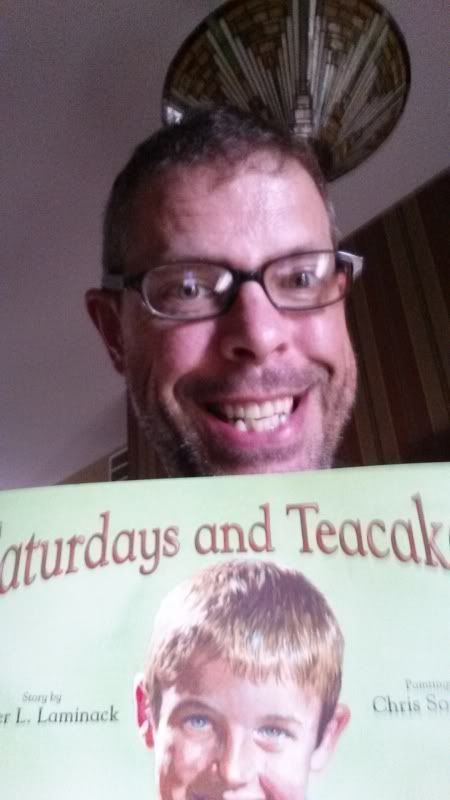
I thought it was time I posted a completely creepy picture of me manhandling a children's book. Actually, I took this as a joke to show Jivey that my long awaited copy of Saturdays and Teacakes by Lester Laminack had finally arrived in the mail. She got a big kick out of it.
I've been hearing everyone rave about this little memoir story in staff developments and team meetings. I've even met the author when he visited our school, great guy by the way. I finally broke down and bought a copy online. But it was taking so long to arrive that I had to borrow a copy from our media center to read to the kids.
The story just wasn't appealing to me. My own grandmother was a large scary woman who had a loud brash voice, so visiting her was not a happy occasion. I just didn't have the same connection that Mr. Laminack was sharing in his story. After all of the peer pressure, I read it to my class. They loved it. But more importantly, I saw tons of great lessons to use this book throughout the year.
Sigh, everyone was right. It does deserve a spot on your Mentor Text shelf.
One of the lessons I taught last week was about sensory details and how it allows the reader to experience the story hand in hand with the author. I pulled a short selection from the text. It starts with the great crafting of
Pedal - Pedal - P-e-d-a-a-a-l-l-l
and end with the crunching of gravel underneath his bike tires as they shower his Mammaw's flowers.
The kids immediately picked up on the use of the stretched out words to show that the author really wanted to show the effort it was taking to climb the hill on a bike.
I had them make a sensory chart for the five senses and we managed to find something for everything, even Taste which is always hard in a story. They could TASTE the salty sweat as it dripped into his mouth.Umm, ew, but okay. Their responses to the text were fantastic. I can't wait to pull the craft into their writing. Check out this Wednesday's post to find out how that lesson went.
Saturdays and Teacakes is a great mentor text to add to your reading list. I promise!
Saturday, August 31, 2013
Wednesday Writing - Play doh models
Scrolling through my daily Bloglovin feed is always rife with inspiration. But what is a wee bit frustrating is the fact that I'll see a great idea, comment on it, and then can't find it again. GAHH!!
I know this idea came from someone's blog that I was reading. She had given her class little tubs of play doh and told them to create something from their Heart Maps (I believe) and then they could write about it in their notebooks.
I liked the sensory idea of building models and then writing off of it. So I commented what a great idea and ran immediately to the local Dollar Store to pick up the 8 pack size of play doh. This means all 26 of my students can get a tub for around $4. Win!
We were doing the whole sensory details lesson with Saturdays and Teacakes on Monday complete with a sensory chart. I had them think of the story we are currently working on and use the play doh to make something or someone from this story. Then to use this visual representation to help generate ideas to fill in their own sensory charts. This way they could use the chart while they are writing and add in great personal details just like Lester Laminack did in his book.
At first I was getting some odd questions from them. "Do you want me to write how the play doh smells?" My response, "Does your character from your story smell like play doh?" "No." "then don't write about how the play doh smells, but really think of any smells you associate with your character."
I went off on a line of questioning about perfumes, or smoke, or drink coffee. They finally figured out what I was after and were happily writing away soon enough. They wrote about hair color, and clothes, and how they taste their mom's biscuits.
I can't wait to see how this enhances their stories.
I know this idea came from someone's blog that I was reading. She had given her class little tubs of play doh and told them to create something from their Heart Maps (I believe) and then they could write about it in their notebooks.
I liked the sensory idea of building models and then writing off of it. So I commented what a great idea and ran immediately to the local Dollar Store to pick up the 8 pack size of play doh. This means all 26 of my students can get a tub for around $4. Win!
We were doing the whole sensory details lesson with Saturdays and Teacakes on Monday complete with a sensory chart. I had them think of the story we are currently working on and use the play doh to make something or someone from this story. Then to use this visual representation to help generate ideas to fill in their own sensory charts. This way they could use the chart while they are writing and add in great personal details just like Lester Laminack did in his book.
At first I was getting some odd questions from them. "Do you want me to write how the play doh smells?" My response, "Does your character from your story smell like play doh?" "No." "then don't write about how the play doh smells, but really think of any smells you associate with your character."
I went off on a line of questioning about perfumes, or smoke, or drink coffee. They finally figured out what I was after and were happily writing away soon enough. They wrote about hair color, and clothes, and how they taste their mom's biscuits.
I can't wait to see how this enhances their stories.
Saturday, August 17, 2013
Wednesday Writing - Marshfield Dreams
Like everything I do, I always looking for ways to make it better. This year I think I found a great way to make my Favorite Places entry in our Writer's Notebook stellar. Thanks to Ralph Fletcher and his amazing autobiographical Marshfield Dreams.

Normally what I would do is take the kids on a tour of the school on the third or fourth day armed with a clipboard, paper and a pencil. We stop periodically and they are to sketch the map of our school. Then I send the students home with an assignment to the same thing with their neighborhood.
The next day I have them use colored pencils to make a mark on both the school and home maps with a Heart shape. This is to be there favorite spot on the map. They also mark a smiley face for a happy memory and an X for some place that isn't so happy. Now they've got six different locations that they can write stories about.
This year, I had a staff development where the Literacy Coach pulled out Ralph's book and I knew I had to use. The inside pages included this very detailed drawing of his neighborhood growing up.
So after we took our tour of the school, I sat them down and read the short entry called Jimmy in Marshfield Dreams. It tells the story of the day they find the mudpuppy in the woods. It's a newt with bright red gills, in case you're curious. Then I sent them home with their assignment.
The student maps were so much more detailed than they've ever been before and I could really see the benefit of having given them a visual to work from before they started.
I can't wait to hear all they stories they have to share.

Normally what I would do is take the kids on a tour of the school on the third or fourth day armed with a clipboard, paper and a pencil. We stop periodically and they are to sketch the map of our school. Then I send the students home with an assignment to the same thing with their neighborhood.
The next day I have them use colored pencils to make a mark on both the school and home maps with a Heart shape. This is to be there favorite spot on the map. They also mark a smiley face for a happy memory and an X for some place that isn't so happy. Now they've got six different locations that they can write stories about.
This year, I had a staff development where the Literacy Coach pulled out Ralph's book and I knew I had to use. The inside pages included this very detailed drawing of his neighborhood growing up.
So after we took our tour of the school, I sat them down and read the short entry called Jimmy in Marshfield Dreams. It tells the story of the day they find the mudpuppy in the woods. It's a newt with bright red gills, in case you're curious. Then I sent them home with their assignment.
The student maps were so much more detailed than they've ever been before and I could really see the benefit of having given them a visual to work from before they started.
I can't wait to hear all they stories they have to share.
Sunday, July 28, 2013
Mentor Text - Social Studies
Those two FAB ladies over at Collaboration Cuties Stacia and Amanda are at it again with their latest installment of mentor texts.
This week's theme is Social Studies! They offered up a great text to include in the study of Native American tribes which fourth grade does every year. I definitely added that to my Amazon cart. Oh, definitely go over and grab the freebie. It's too awesome when you are starting up interactive notebooks. It will help students get ready for working with longer texts more independently.
For my installment, I want to share a book I was introduced to least year during our study of the American Revolution. It's called The Scarlet Stocking Spy by Trinka Noble. It's an incredibly moving tale of a young girl who helps craft a code with her soldier brother to pass information around about British ships in the harbor.
Here's Amazon's write up:
Philadelphia 1777 is no place for the faint of heart. The rumble of war with the British grows louder each day, and spies for and against the Patriots are everywhere. No one is above suspicion. Still, everyday life must go on and young Maddy Rose must help her mother, especially since her father's death at the Battle of Princeton and now with her beloved brother Jonathan off with Washington's army. But when childhood games become life-and-death actions, Maddy Rose is drawn ever deeper into events that will explode beyond her imagining. As young America stands on the very brink of its fight for freedom, it becomes clear that even the smallest of citizens can play the largest of parts, and that the role of a patriot has nothing to do with age and everything to do with heart. In The Scarlet Stockings Spy, Trinka Hakes Noble melds a suspenseful tale of devotion, sacrifice, and patriotism with the stark realities of our country's birth.Noted picture book author and illustrator Trinka Hakes Noble has pursued the study of children's book writing and illustrating in New York City at Parsons School of Design, the New School University, Caldecott medalist Uri Shulevitz's Greenwich Village Workshop, and New York University. She has authored and illustrated numerous books including the popular Jimmy's Boa series, which has been translated into six languages. Trinka lives in Berrnardsville, New Jersey. The Scarlet Stockings Spy is her first book with Sleeping Bear Press. Because Robert Papp's childhood drawings of his favorite superheros were such a pleasure, it was only natural that he would wind up an illustrator. Nowadays, his award-winning artwork appears on book covers and in magazines instead of on the refrigerator. He has produced hundreds of cover illustrations for major publishers across the United States. Robert lives in historic Bucks County, Pennsylvania.
I must give you full warning to be prepared for the ending. I wasn't expecting it and was shocked into stopping for a bit to catch my wits. Just make sure that you read it through for yourself first.
Labels:
American Revolution,
Mentor Text,
social studies
Tuesday, July 02, 2013
Wednesday Writings - Mentor Text
TWO LINKY Parties for me in one day!
I love writing. Words fascinate me, especially how several different people can take a handful of words and put them together is such different ways. Writing is a way to express your soul and connect with others through visual experiences. Writing opens up doors and gives people impressions of you before you even walk in. I love writing.
For this week, I thought I would try up a LINKY party with those Collaboration Cuties. They are compiling a list of great mentor text to use at the beginning of school. Check out their site for a terrific list of books to use when those fresh new faces wander into your room.
My book choice for the sheer fun of it is definitely:
I Wanna Iguana by Karen Orloff and David Catrow is a personal favorite. The letters written between an overeager son trying to convince his mother, and a mother having some serious doubts is wonderful. I think it's the illustrations that really grab me about this fun little nugget. They just so fun and goofy that the kids love looking at the book over and over.
I would use this text to get them started thinking about the Opinion Genre (Persuasive in another life). They have to express and opinion and back it up with proof, just like Alex in the story. He does do a little begging, which is a trap we don't want students falling into when writing this genre. Rather, backing up your ideas with evidence will convince your reader to agree with you. The students would write to me or another student in regards to something they feel strongly about. Then that person has to write back to give the author that sense of communication, just make sure to remind them to be positive with their responses.
If you like this one, you'll love the new edition to the series: I Wanna New Room. Check them out.
For my second Linky of the day (last week, I didn't even know what a Linky was, ha!) I am linking up with Ideas by Jivey for her ideas on setting up a workshop in your classroom. Since my topic today is Writing, I will stick with that.
One of the things I do before the kiddos arrive is to create a Steps to Good Writing board. This is an area in the classroom where the students come up and move a clothespin from each of the steps to show where they are in their writing. This way I can quickly see who is spending too much time in the Drafting stage. Now I've used tons of things for this in the past. I've had separate pieces of paper, plastic plates, one long wall chart, etc for the students to show where they are. None of these has worked perfectly for me. The chart gets ripped, or the clothespins don't stay on the plates and they fall behind my bookshelves (GRRR). If anyone has the perfect method for this, PLEASE PLEASE PLEASE leave me a comment below!
The Steps I use are Planning, Drafting, Revising, Editing, Peer Editing, Final Draft, Publish. Each has a little reminder about what to do at each step. I am going to try and provide you with what I remember for each of the steps. Since I'm not at school right now, I don't have easy access to my files. So bear with me.
Planning: (15 min)
*Get your ideas down
*Jot down everything you know
*This is not the time for complete sentences
Drafting: (1-2 days)
*Choose one idea from your jots
*Jot everything you know just on this topic
*Choose one main character and two supporting
*Don't worry about spelling
*This is your Rough Draft
*Skip lines
Revising: (1 day) I usually attach a colored pencil to this step so they remember to use one for revising
*Make your verbs stronger
*Add sensory details
*Organize your thoughts
*Look for moments to EXPLODE (give more information to your reader)
*Take away extra ideas
Editing: (1 day) A different colored pencil is attached
*Check all spellings
*Watch your punctuation
*Have you capitalized correctly?
*Does your story make sense?
Peer Editing: (10 mins)
*Read your story outloud to a partner
*Partner is allowed 3 suggestions
*Make changes with colored pencil
Final Drafting: (1 day)
*BEST handwriting
*Don't skip lines
* INDENT
Publish: (1 day)
*Create a cover for your story
*Think about new ideas
Hopefully this helps you out as you get started in your Writer's Workshop!
I love writing. Words fascinate me, especially how several different people can take a handful of words and put them together is such different ways. Writing is a way to express your soul and connect with others through visual experiences. Writing opens up doors and gives people impressions of you before you even walk in. I love writing.
For this week, I thought I would try up a LINKY party with those Collaboration Cuties. They are compiling a list of great mentor text to use at the beginning of school. Check out their site for a terrific list of books to use when those fresh new faces wander into your room.
My book choice for the sheer fun of it is definitely:
I would use this text to get them started thinking about the Opinion Genre (Persuasive in another life). They have to express and opinion and back it up with proof, just like Alex in the story. He does do a little begging, which is a trap we don't want students falling into when writing this genre. Rather, backing up your ideas with evidence will convince your reader to agree with you. The students would write to me or another student in regards to something they feel strongly about. Then that person has to write back to give the author that sense of communication, just make sure to remind them to be positive with their responses.
If you like this one, you'll love the new edition to the series: I Wanna New Room. Check them out.
One of the things I do before the kiddos arrive is to create a Steps to Good Writing board. This is an area in the classroom where the students come up and move a clothespin from each of the steps to show where they are in their writing. This way I can quickly see who is spending too much time in the Drafting stage. Now I've used tons of things for this in the past. I've had separate pieces of paper, plastic plates, one long wall chart, etc for the students to show where they are. None of these has worked perfectly for me. The chart gets ripped, or the clothespins don't stay on the plates and they fall behind my bookshelves (GRRR). If anyone has the perfect method for this, PLEASE PLEASE PLEASE leave me a comment below!
The Steps I use are Planning, Drafting, Revising, Editing, Peer Editing, Final Draft, Publish. Each has a little reminder about what to do at each step. I am going to try and provide you with what I remember for each of the steps. Since I'm not at school right now, I don't have easy access to my files. So bear with me.
Planning: (15 min)
*Get your ideas down
*Jot down everything you know
*This is not the time for complete sentences
Drafting: (1-2 days)
*Choose one idea from your jots
*Jot everything you know just on this topic
*Choose one main character and two supporting
*Don't worry about spelling
*This is your Rough Draft
*Skip lines
Revising: (1 day) I usually attach a colored pencil to this step so they remember to use one for revising
*Make your verbs stronger
*Add sensory details
*Organize your thoughts
*Look for moments to EXPLODE (give more information to your reader)
*Take away extra ideas
Editing: (1 day) A different colored pencil is attached
*Check all spellings
*Watch your punctuation
*Have you capitalized correctly?
*Does your story make sense?
Peer Editing: (10 mins)
*Read your story outloud to a partner
*Partner is allowed 3 suggestions
*Make changes with colored pencil
Final Drafting: (1 day)
*BEST handwriting
*Don't skip lines
* INDENT
Publish: (1 day)
*Create a cover for your story
*Think about new ideas
Hopefully this helps you out as you get started in your Writer's Workshop!
Subscribe to:
Posts (Atom)